



Features | Lists
By The Staff
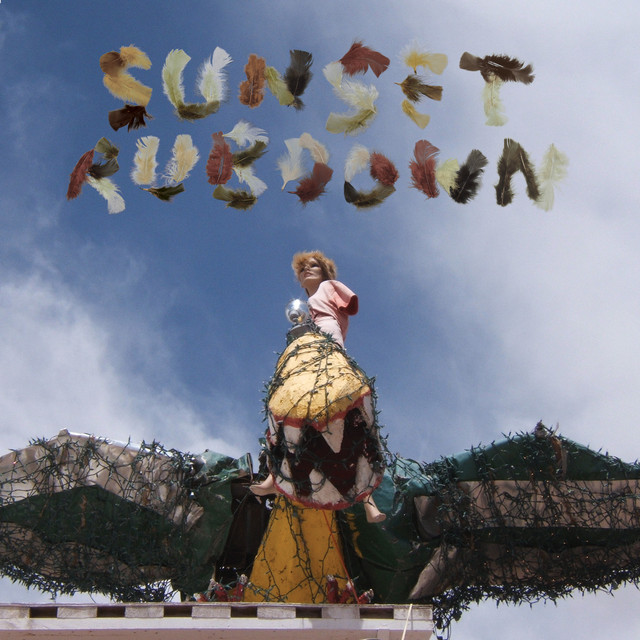
10 :: Sunset Rubdown
Dragonslayer
(Jagjaguwar)
In his track review of “Apollo and the Buffalo and Anna Anna Anna Oh!”, our own Clayton Purdom articulated a common anxiety among the people who’d loved—albeit with the requisite concessions—the sprawling, lovely, and undeniably masturbatory Random Spirit Lover (2007): “Guys, I don’t want Spencer Krug to turn into Dan Bejar.” Because shit was looking a little scary for a minute there. Random Spirit Lover’s bloated indulgences sometimes undermined its soaring high points and the unimpressive eleven-minute finale of Wolf Parade’s At Mount Zoomer (2008) left some of us wondering if Krug would ever again be capable of expressing anything as masterfully concise and free of references to centaurs as “I’ll Believe In Anything.” Dragonslayer, then, greeted us this summer like a revelation. It is a triumphant exercise in self-editing, a staggeringly listenable distillation of a lot of challenging ideas; it is Krug’s definitive “I Am Not Dan Bejar” record, and not a moment too soon.
Dragonslayer represents a substantial step forward for Krug as a writer: its songs are consistently tighter and its thematics are simultaneously more complex and communicated with increased lucidity. It’s by far the band’s most accessible record, but that doesn’t mean it’s watered down—there are just as many self-referential moments, just as many “Wa-ah-oh-oh-oh“s, just as many references to Icarus (maybe more). But there are also bouncy, syncopated hooks and guitars that sound not like rainfall on a distant, most assuredly radioactive planet but actual fucking guitars. Songs like the thumping “Idiot Heart” follow hooks with even more climactic hooks, never stopping to dwell like proper choruses, instead barreling on with ever-accumulating energy towards logical and logically epic conclusions.
But it’s the record’s lyrical depth that bumps Dragonslayer up from awesome to downright game-changing (in which the players are the members of Swan Lake and the game is Scrabble, probably, or Taboo). The whole thing’s haunted by the spectres of shoddy representation, as in the unmistakably self-reflexive and self-deprecating line, “The stupid house you made / Fell away like paper lace,” on the melodious “Paper Lace.” The record’s thematic and emotional centerpiece, though, is the stunning “You Go On Ahead (Trumpet Trumpet II).” I don’t know that Krug’s ever put together a more candid (or, really, better) song. Few songwriters have written anything quite so affecting about the spiritual exhaustion that comes along with being a songwriter (think “Paint A Vulgar Picture,” but less cheeky); though Krug’s authored many a line that dazzles with complex imagery and eccentric narrative, I don’t think he’s ever punched me in the gut quite in the way he does when he delivers the uncharacteristically stark, “I’d like to think I am not one of them / But I know I am.”
When a first person pronoun weasels its way into a Sunset Rubdown song, it’s usually so firmly entrenched in its own impenetrable mythology that I’d rather just pass on attempting to deconstruct all the layers of identity to get to the actual representation of the songwriter. But something about this record convinces me that its “I“s are all Krug, the hopelessly unknowable maestro. Dragonslayer is, after all, an achingly personal record about the trappings of artistic creation, about the frustration that nothing ever comes out as good as you plan, the isolation that results when you crawl too far into your own ornate stories, and the sort of destruction your art can so easily wreak on your relationships with other people. The whole album—but specifically the sublime finale “Dragons Lair”—has the feel of the final scene in 8 ½: Krug holding hands with all his bizarre, self-referential creations, momentarily letting go of all the emotional exhaustion they’ve wrought, and instead skipping around to a wistful, joyous, and altogether hummable tune.
Lindsay Zoladz
9 :: OOIOO
Armonico Hewa
(Avex/Thrill Jockey)
What is it exactly that OOIOO do that we can speak about without relegating seemingly patternless but tightly controlled, largely intuitive but consistently surprising, genuinely exotic music into bum categories for people who only see four Japanese women? There’s a real temptation to marginalize Yoshimi, Kayan, Aya, and Ai, to overemphasize ethnic difference when it’s artistic uniqueness that resonates from every dense moment of Armonico Hewa. Its appeal should transcend it from niche curiosity to something undeniable. Preferable, then, to see the four as nodes on an electrical grid, each contributing an essential frequency to a dynamic tension, an intractable and infectious rhythm of energy that builds and releases over and over. After all, all that OOIOO do is put on a clinic in Kraut-pastiche-post-World-rock n’ roll-brain fuck.
But the temptation is there because OOIOO are putting all kind of “others” in a blender and hitting the liquefy button, many of them the convenient categories provided by World music. If it was simply a matter of their leaning post-rock polyrythms up against one another then we could talk about how Armonico Hewa sounds weird in a completely predictable way. But “Konjo” slamming mechanically into “Ulda” is unquestionably, wonderfully weird, in addition to being enthralling, rejuvenating, and endlessly listenable. “Polacca” likewise lays down some “I Zimbra” perfection for all of its bejeweled eight minutes. The gradual speed up into the prog-metal hooting in “O O I A H,” and then the endlessly creative drumming getting more complex still, is simply great fun to listen to. We want to talk about how this weird album must be weird because four Japanese women produced it. Really it’s because those four Japanese women happen to be too talented not to make music that slays our preconceptions.
Mark hinted in his review that the album is, ultimately, onomatopoetic, and it is. It runs fluid from track to track, sounding completely natural—as if a danceable record with a map of the world on its face weren’t some kind of staggeringly professional achievement. And it’s on Armonico Hewa that the universality of the band’s emphasis on rhythm and pseudo-language blossoms fully, somehow one-upping Taiga (2006). One thinks this kind of thing should peep meekly from the “Misc” box of your indie record store, should be the thing of ironic grins. Instead it ends up being the sort of record that changes the way you listen to records and taps (taps hard) that reptilian brain that never forgot about great music.
Conrad Amenta
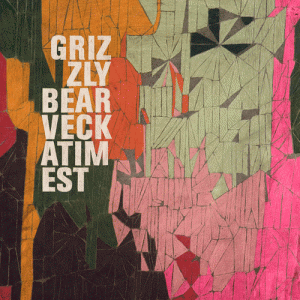
8 :: Grizzly Bear
Veckatimest
(Warp)
The hyperbolic thing that I want to say about seeing these guys play live is that they can actually do it: that there are four guys that can go onstage and perform this music live with your standard “rock music” instruments. This seems impossible in light of, like, the actual album. It is architecturally astonishing stuff, almost Catholic in its grandiosity, a complete thing of vaulting choruses with huge sighing verses buttressing them in rows of perfect, graceful arc. That the record can be at once so large and so elegant is what staggers the listener as she moves through it, from days into months. I would that I was above something so straight-forward and sincere and, you know, indie, but I have swooned to this record. And I didn’t need Hova’s co-sign on this, but it didn’t hurt in realigning a certain perception of this record’s appeal. There’s a rich Late Registration (2005) bounce here on “Two Weeks,” a boom-bap to the coo of “Cheerleader,” a feeling when the chorus locks into place on “While You Wait For the Others” that feels, somehow, More than indie rock.
But it’s not. It’s four dudes, with guitars and drums, playing songs that they wrote, singing, etc. And it’s the end of the year; I’ve admitted some things to myself. So: so be it that it is an indie rock record and also one of the year’s very best of any variety, because a release of this quality lends credence to the entire affair. What, in the end, and in my book, triumphs over hyphenated mini-genres and five minute mp3 half-lives is not innovation or controversy or cool, which all can be found elsewhere and higher on this list; it is something simpler and better and, as Veckatimest’s right grand appeal proves, something rarer. It is, rather, beauty: both the raw material with which this cathedral was built and the sky into which its highest towers vanish.
Clayton Purdom
7 :: Tim Hecker
An Imaginary Country
(Kranky)
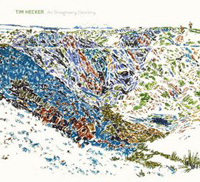
Though probably his most accessible and, I’ll admit almost-shamefully, his most enjoyable, Montreal-based Tim Hecker’s sixth LP, the indomitable An Imaginary Country, is, by sheer size alone, the most overwhelming record of the year. Ambient music only in how precisely it can fill and define any space it inhabits, head- or otherwise (I’d recommend a long drive up the Oregon coast during a blustery March; that’s when this record almost killed me), prog only in how arterially it grows and multiplies, the stuff of An Imaginary Country accomplishes a kind of grandeur that, to continue with the hyperbole so redolent in our Top 10, is limitless in its scope. Amorphous, ambitious, captivating, and every ten minutes simply too much, what Hecker’s able to develop through frothing synth lines, a few guitar effects, and a shallow fishtank of soft-rock clacks is, in gentle shifts and violent volume, a mounting, epochal character arc: of a song, of an album, of art, of an artist’s career, of a massive, enveloping landscape and thus of a song, album, and art again, all symmetric and mutable and totally ready to turn on itself. From opener “100 Years,” where a slight notion of melody germinates and external, elemental forces push it to expand and take shape, to closing “200 Years,” where that same melody is crushed and swallowed by the same forces that once nourished it, the album takes on an annular cadence and, despite lacking any solid shape, becomes discernibly whole—even as it’s about to flip back to side A and go at the process again. An Imaginary Country isn’t so much a geographical endeavor, like Tolkien sitting down at a table reserved explicitly for made-up cartography, it’s a document that is solely about, and seems to exist only to propagate, its astounding size; a collection of music that not only harnesses but dwells within the terrible power of creation—not the physical act itself but in the magnitude of the imagination that is sometimes wielded and needed in reaching a moment of conception and successively, one hopes, a thing of beauty.
Dom Sinacola

6 :: Burial + Four Tet
Moth/Wolf Cub
(Text)
This hook-up arrived on a wave of hype that could launch a thousand Guinness ads. What could a Burial + Four Tet twelve-inch mean? Split? Picture disc? Collaboration? Pizza? Text Records was saying nothing, even going so far as to disclose not a single fucking sausage about what two of the UK’s most championed loners were up to. Blogs buzzed with talk of an album. Boomkat shat itself at least twice.
The result was a collaborative play-off that harks back to Albini’s dabblings with Labradford and a perfect one of those “Shit! That was eighteen minutes?” records that no one with brain activity should do without. Bevan and Hebden made a sound without seams, one that lowers a microphone onto both nerds conversing rather than split them and giving each of them their nine minutes. Their lively nocturnal electronica is infectious as soon as the needle makes contact, with “Moth”‘s shimmering twitch giving readings we hoped both artists might come up with: disco vibe intro, post-rock hieroglyphics, a beat that could cripple a beltway. Burial’s suppressed trance-love pervades the track like the mist round a sub-zero streetlight, and you can see why the piece was named after the singed things with wings that crash into them.
Fortunately, side B comes to the rescue with a lost Ridley Scott soundtrack, turning comedown judders into that bizarre second wind of 4am private resolve. Ever had that thing where you give up on counting sheep and switch the TV on just in time for the escape scene from Heat? Here’s that compressed into a cycle of jungle widgets. Growing out of—what, windchimes? (Eat that, Hyperdub credibility)—“Wolf Cub” feels epic without the threat of violence, building into a dreamboat Orbital remix that the Hartnoll brothers forgot to commission: nicely chilled, thin-spread chimes, then you’re taken down a 2-step tangent with streetwise drum blocks and ghost moans. There’re none of the coke thrash heartbeats that might signify an ambassador of dubstep here, and Four Tet’s sweeping keyboard line lets things bloom into a perma-flipped opus. But there’s truly no telling who does what, whose intentions take precedence at which moments, so I recommend you double dip on this one so you can out-mix the switch-over interlude. You don’t want to interrupt one of the year’s finest coming-togethers.
George Bass
5 :: A Sunny Day in Glasgow
Ashes Grammar
(Mis Ojos Discos)
Getting lifted sounds like an impossibility at the moment: 2009 certainly wasn’t a year for swooning. There just wasn’t much time for it, what with all the yelling, sobbing, and giving up. The median price of a home in Detroit ironically dipped to the cost of a new Hyundai and Obama’s sheen hasn’t yet rescued the spirits of mothers and fathers raising their kids in motel rooms—it’s not Glenn Beckian to say circumstances for many have been soul-sucking. Finding ourselves in any sort of funk, be it emotional or financial, it seems in these times that America could use a break-up record, though I’m not sure I trust us to choose the correct one. I mean, we looked to the vague anthems of Enya and Bono after 9/11, and they are both very Irish and very terrible.
So, while A Sunny Day in Glasgow sound like a Belle & Sebastian album title, they are just the Philadelphians to pass healthcare refor—erm, make you feel a little less heartbroken when the government mandates the evacuation of Flint, Michigan. Its tonic isn’t distraction, just beauteous solace, intimating devastation while sounding pristine and whole. Melancholy rarely comes in shades this vibrant; clamoring synths and flitting guitars meld effortlessly, pleatless, to create a dreamlike state at once vivid and stirring, but bent with a surreal detachment. What I’m describing sounds bodiless because there is little here to physically grasp: the poignancy of this record doesn’t exist in songs but in miniscule moments, in the way the vocals and drums on a specific track hit as precisely and ephemerally as points of light.
And while I’m almost positive my appropriation of ASDIG’s spacious pop does not fall in line with the attitudes of those involved in its creation, as “Failure” implores the listener to “Fall forward / Feel failure,” it’s damn tempting regardless. Lofty ideals and the pressures of greatness can be exhausting, after all. Ashes Grammar is the sound of turning off the news, pulling the covers over one’s head, leaving redemption for tomorrow—but with romantic guitar tones. Everybody hurts, and this is the national group hug.
Colin McGowan

4 :: Animal Collective
Merriweather Post Pavilion
(Domino)
Contrary to the kind of implicit assumptions made about Animal Collective, their career is not on some kind of pre-established arc that naturally propels them towards pop accessibility or greatness or both. I realize this is a hard fact to contend with, considering that every Animal Collective album is always the best Animal Collective album ever but only until the next Animal Collective album. The exponential praise heaped on each successive recording is so overwhelming it can be tempting to want them to fail just to get it over with. Nor is Merriweather Post Pavilion their indisputable masterpiece, not that such a thing can really be established; I’d still take Strawberry Jam (2007) or Here Comes the Indian (2003) over this one. The dub production and the lack of gnarl in Avey Tare’s voice (which made “Fireworks” and “For Reverend Green” so incredible) seemed like drawbacks to me, at least at first. “Taste” drags and seems like a weak contribution to a debate about the over-accumulation of music/cultural objects that I don’t really want to be a part of.
In the end Merriweather Post Pavilion succeeds (mostly) and fails (slightly) as a pop record, which is what makes it so staggering and, almost paradoxically, greater than the sum of its imperfect parts. Like post-Pet Sounds (1966) Beach Boys records, it transforms banality into moments of pure brilliance that feel like they should be staple Pop Writing 101 tricks rather than just ephemeral nuggets; unlike those records, the ratio of these moments to tepid filler is actually great enough to listen to it front-to-back. It seems almost pointless to list them, but fine: the vocal glissandos on “No More Runnin’” which descend slowly than bust out with churlish delight; the way Panda Bear sings “just a sec more in my bed” on “Daily Routine” as if he could actually slow down time; the way “In the Flowers” epitomizes what an opening track should do, beginning in a blurry haze and growing up all around you only to retreat again into the shadows.
Zadie Smith once made a critical observation about beautiful women, noting they “do not descend, as was once supposed, from on high, attached to nothing other than wings. [They are] from somewhere.” I would make a similar observation about the consensus choice for best song on this album, “My Girls.” Remember when it was called “House” and then “Material Things,” or when it was performed with buck-teethed awkwardness at Coachella? Unlike any other bona fide pop band, Animal Collective come from somewhere, a place of abstraction and scary chanting and spaced-out knob twiddling jams. In a year where nostalgia became one of the most bankable commodities for fickle hipsters, Animal Collective had already moved on, earning their right to praise stability—is there anything more physical to sing about than “adobe slabs”? If there is a trajectory across their career it’s one of constantly re-forming the past into something concrete that will hold up under the ever-shifting weather of taste.
Joel Elliott

3 :: DOOM
Born Like This
(Lex)
Born Like This is pure pulp revisionism, a modern-day pantomime in which our supervillain wanders the audience box and basically gives everyone the willies without trying too hard. That’s DOOM, and this is his album. It is all the things its title suggests: a ceaseless affirmation of the self, a waggling-fingered forage into history personal and not, plus also a quite unusually sunny take down of, I guess, Life, capitalized, in general. You will leave this album more cheerful for its existence.
DOOM breaks out some of his best beats yet, chopping a cigar-smoking Charles Bukowski into the vulcanized chaos of “Cells” only to play it as straight as a railroad on the fly-as-fuck “Still Dope.” Elsewhere he lends Raekwon a rolling ball of obscure hairy trauma (“Yessir”) and foregrounds some of his own batshit verses with keepsakes from Dilla. On the masterful “Supervillainz,” chest-fluttering drums are counterpoised against fucking Autotune, the overall effect one of a full-color artist on the loose with a bucket of paint and his own lyrical feathers to tar on. And if DOOM does spend this record shredding through a series of paper rosettes (“Microwave Mayo”), then it’s still this year’s most assured, most deliberately fun performance, Dumile’s voice itself sounding like a squashed bug at the intersection between forward-facing bangers and a dazed-out drawl.
This a sonic drill-ground, there are no hooks. This is the voice of one man coming at you with a cane—he is socially amoral, technologically canned, and he makes it his point to come up right to the centre of your frame and gurn. No doubt about it that dude is a bit mental at times: check the chest-beating, sing-out end to “That’s That,” the man-on-acid parade that is “Gazillion Ear.” If beats are supposed to act as a sort of natural environment, take this as him cutting down each and every tree and then dancing on the treetops he’s littered on the ground. An opium eater, a loiterer, and an ecstatic dreamer—Born Like This permits us direct access to this man’s bobbling conscience. He’s deadly mean, but not above playing it human now and again. And this is his new punchdrunk manifesto.
Alan Baban

2 :: Phoenix
Wolfgang Amadeus Phoenix
(V2/Loyauté)
Wolfgang Amadeus Phoenix is a blockbuster of Dark Knight proportions, and like Dark Knight it bares a quantum-leap-forward relationship to its predecessors. Wolfgang Amadeus Phoenix’s meticulous arrangements and fat, stadium-ready production place it miles beyond the early scrappy stuff on United (2000) and the promising It’s Never Been Like That (2006). What’s past is prologue, and each of Phoenix’s previous albums must be understood—like the Beach Boys’ Today! (1965) and Summer Days (and Summer Nights!) (1965)—as leading up to, developing skills for, and breaking ground toward this, their magnum opus.
The opening one-two punch of “Lisztomania” and “1901” is indicative of the album’s movement toward and away from its own core style. The former track is simultaneously one of the best of the year and, as a jaunty little piano pop tune, an abstraction from WAP’s bread-and-butter, better represented by the synth-soaked latter tune. Having thus thrown down the gauntlet the album moves away again with the laid-back sunny disco of “Fences” and the still-controversial “Love Like a Sunset” only to return with “Lasso.” The album thus exists in a circular but inverted structure of theme and variations where the variations come first.
This willingness to lead with gestures outside the album’s wheelhouse is mirrored in the risks, breaks, and fissures the band allows into their songs. Thomas Mars’ melodies are each a long series of small hooks strung together, with the seams between “I’ll be anything you ask and more,” “goin’ hey hey hey hey hey hey hey,” and “fold it, fold it, fold it, fold it’” eminently visible. “Armistice” falls into and out of drumbeats nearly as quickly, and in what might be the album’s most transcendent moment the band allows all of “Rome”’s complex architecture to fall away upon the entrance of a staggering, pulsating synth that enters in the song’s second third. Thus the album bobs and weaves, breaks and comes back together, with the boldness of artists so entirely in control of the momentum and pacing of their record that they never have to worry about losing it.
Mars has a lightness, a kind of thwarted power, to his voice that lends these entirely unironic songs a kind of shield against being too sentimental. Moments that would be cringe-worthy in other singers’ hands—“Who’s the boy you like the most?”—are rendered fragile and contemplative by his unadorned, plain-sung vocals. Though more obvious in their live show, Mars’ ever-so-slight French accent/delivery furthers this distance—his delivery is less the spontaneous, ecstatic expression of his heart and more the labored-over musings of his intellect. Thus Phoenix’s pop is as thoughtful as it is celebratory, and the strange repeated words that pervade this album become in repeated listenings a surprisingly profound meditation.
And so WAP is a fat-hooked stab at mainstream success, its singles licensed to Cadillac and the USA Network, while remaining a thinking-person’s pop record: it is perpetually striking in the fineness of its craft and the dogged pursuit of its vision. It contains several of the year’s best stand-alone tracks and yet each is improved in context. In its meticulously detailed sonics, its sheer depth, it deflects all charges of “sell-out!” or “over-produced!”, allowing even the most standoffish of listeners into its big, big tent. The band fires on all cylinders (cracking beats, sinewy guitars, languid synths) when they want to and pulls everything back to a whisper the next moment. Wolfgang Amadeus Phoenix stands as a staggering achievement in a host of categories, but most important? It is quite simply the album of our moment, indie rock’s last word in this decade and a pair of big shoulders to stand on in the next.
David Ritter

1 :: Raekwon
Only Built 4 Cuban Linx 2
(EMI)
If you had told me a year ago that Raekwon’s Only Built 4 Cuban Linx 2 would be the Glow’s AOTY, I could only have assumed that it would be a record which exceeded all our expectations, that defied the very impossibility of a rap “sequel” being great, that maybe even was almost as good as the original. Well, here we are now, I’m writing this #1 blurb, and none of that is exactly true. Firstly, our expectations haven’t been “exceeded” so much as met, but they’ve been met in a way that is so amicable and deeply satisfying, it’s like Raekwon knows what we truly need from him as opposed to whatever neo-Wu shit we may’ve thought we wanted. And, really, the fact that this record doesn’t disappoint is in itself a vault over grounded expectations. Secondly, history’s got my back on the impossibility of good rap sequels: don’t let the “II” on Bizarre Ride (1992) fool ya; come forget The Gift & the Curse (2002) with me. Raekwon eludes that impasse by virtue of OB4CL2 not being whatever it is a rap sequel is supposed to be. It’s not a continuation of narrative or a trifle cash-in; it’s the same narrative and that’s not expected to make bank. Dramatis personae enter and exeunt, lights change, but the Chef’s word remains constant, resolute, soliloquy trill. So, no, OB4CL2 isn’t better or as good or almost as good as OB4CL. But for all the differences in production and references, the unspeakable beauty of OB4CL2 is that (thirdly, by the way) it speaks in OB4CL tongue to the unspeakable beauty of OB4CL, of Wu-Tang Clan, of 1995, of an origin to music that is all that music needs. It’s about something deep within hip-hop that’s been crystallized, made immutable.
The question begged is “what does it matter?” 2009 screams for us to snap out of it, to realize that this was the year of Lady Gaga, of “Right Round” and “Birthday Sex,” of Jon minus Kate divided by kids, of a thousand other tawdry “indiscretions” and “transgressions” piled to the heavens, steaming rank fumes all over this goodness-starved nation, this land which can (on a populist level, at least) only seem to find solace from recession in the arms of inanity and the publicized miseries of others and “I’ma let you finish” memes. I do it, too, and it might be killing me; Obama’s face already feels like a daydream. Utter shite itself has become our warmth and sustenance. Even esteemed colleague Clay loves that Drake mixtape and that Soulja Boy single and, the thing is, he is quite correct in doing so. These are the documents of our times; wittingly and unwittingly, they reflect who we are and the state we find ourselves in and the things we do to distract ourselves. How could any of us not respond with some acceptance of such truth, regardless of how sad or ironic or fucking stupid (Soulja: “Took a look in the mirror and said ‘what’s up?’”) it is?
Except that OB4CL2 has a better way. Raekwon, Ghostface, and company don’t compose a document “of our times” but a document that is both outside and within those times, lacing our present into the fabric of a bigger story that started with “catch the blast of a hype verse / my glock bursts, leave in a hearse, I did worse.” It doesn’t separate itself from the shit-pile; no, it surveys it all, savagely roots up the most foundational deposits of festering excrement, hurls some at us (one need look no further than Ghostface’s appalling verse on “Gihad”), and yet through it all it remains untainted. Raekwon’s latest testament to the mettle he and his comrades eat for breakfast bears an uncompromising philosophy, a wit that knows no stymie, and an artistry that coasts on friction-free momentum through realms of the highest order—a hallowed place where zeitgeist and/or good looks aren’t enough to gain entry, not even when they openly display the burdens that come in tow. Sorry, Drake. It feels too natural, the way the same street rap Raekwon has always executed with such casual precision suddenly doubles as the rap that most passionately, sweepingly, and chillingly dissects the pithy desperation of 2009. Vivid jeremiad “Cold Outside” could have been put to tape a decade ago but it makes as much sense now as it ever would have then. And the rub of grit also renders the record’s sound atemporal: the drums on “Penitentiary” would be hard in the Stone Age and they’ll be hard in 3046. OB4CL2 doesn’t even have to draw parallels; it just draws blood from the heart of Wu-Tang.
RZA only produces a few tracks but the fingerprints of his M.O. are conspicuous even as Raekwon stays, triumphantly inert, within his own little wheelhouse; it’s as if the Chef faithfully scrutinized the Prince’s original ink-and-parchment manuscript for the Wu-Tang Manual and then used its pages to, like, roll blunts and chop crack. Which is the same thing he did on OB4CL, really, before the Wu-Tang Manual was even published. In fact, Wu-Tang as viewed through the finder of OB4CL2 is a script with no real beginning, no climax, no denouement. It becomes a plateau of rising action in endless cycle—in one vicious, dirty, idyllic loop that lasts all of eight seconds, no matter how many strings RZA might now choose to put on top. But what keeps OB4CL2 from sub-genre insularity (Wu is a sub-genre, you understand) is how it envelops the rest of a revered breed of hip-hop; everything here reeks of Ol Dirty’s memory but how much more haunting is it that he’s elegized over a Dilla beat (“Ason Jones”)? Or can Dilla even be dead when tracks like “House of Flying Daggers” and “10 Bricks” resound so vibrantly and indelibly? On this meta-trend, metaphysical, meta-time stage Ghostface and Method Man sound absolutely invigorated while non-Wu others find an opportunity to affirm the old holding patterns we cherish: Slick Rick tells stories; Beanie Sigel raps gorgeous sad shit about prison and getting old; Jadakiss breathes. This is where all that wonderful stuff belongs eternally, like a veritable Nexus for ’90s rap. Even West Coast grandpappy Dr. Dre and senile elder statesman Busta Rhymes can’t escape the tinge of old/new relevance, acquired in what must feel like the former life of “About Me.” So, God bless you, Chef, for forcing the axiom to ring true while extending that truth’s reach: Wu-Tang is Forever…and as long as Wu-Tang lives, so does raw hip-hop.